
|
riddle me this plane
So -many planes:
Get them all "guessed" at FIX and they all change at impact. Here is a big one. COG pull causes toe down at speed. The shaft is now bent in an arc. the grip now points, not at the hossel, not at the cog but, because it is a tangent to the arc of the bent shaft caused at toe down, out beyond the toe of the clubhead. But how much? What is the correction? how is it added? Tell me what becomes the feel at pp #3? Not an Easy Riddle. Hint- I have posted the solution as I see it some time ago. hb |
Quote:
|
Quote:
We can restrict the scope to the Impact Interval because Ball response depends on that. The Lie Angle of the Club affects direction. If the Hands are too low, then the ball goes Left, if too high then the ball goes right. It's named "Swing Plane" because we will Swing the Club along this Plane. So the Swing Plane is built-in to the club, and it's normally somewhere between the Shoulder and Elbow planes. Our job begins by aligning the ball, low point and the target to this plane. Low point and target are already reconciled. Just get the ball right. Ben Hogan, in his book "Five Lessons" made an obvious mistake and he himself contradicted this illustration in numerous interviews and demonstrations. 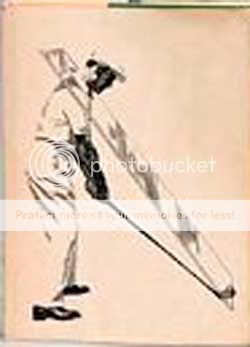 |
Quote:
HB |
Quote:
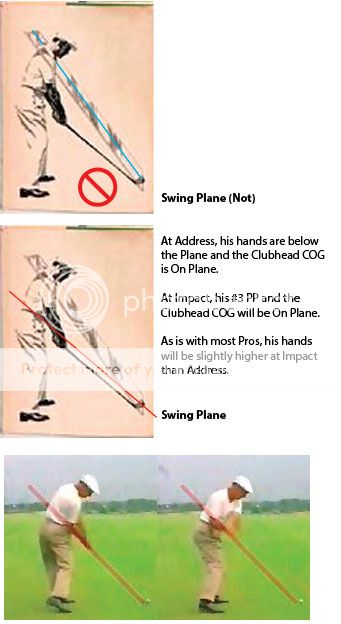 One point to make is that there are 3 Planes. Left Arm Wedge, Right Forearm Flying Wedge and Swing Plane. Although its possible to align the Flying Wedges at 90 degrees and thus have the Club on both of these Planes simultaneously, the Left Arm Wedge Plane is Opening and Closing (Turning and Rolling) and cannot directly move the Club along the Swing Plane. It can do so under the guidance of the Right Forearm Flying Wedge. |
Turning Shoulder Plane
I've been talking about hand paths in the context of the Turned Shoulder Plane because it's the most common, but let's look at the Turning SP - the version with vertical moving arms. Homer says the hands trace a line on the ground INSIDE the base line, so in this case, the hand path NEVER lies in the Swing Plane, unlike the Turned SP in which the hands trace the baseline from the Top.
|
Quote:
|
Quote:
http://www.lynnblakegolf.com/forum/post94266-1.html So, in the context of this post, post #1 of this thread is not practical? Hogan just said DON'T GO ABOVE the glass plane and the DOWN SWING plane is relocated BECAUSE OF AXIS TILT. Hogan did not talk about COG plane or "sweet spot" plane. Likely because he was smart enough to know it was not useful to the golf swing beyond an accademic curiosity. HB |
Quote:
I've made BOLD in the quote below, an important point. Also, it may have been widely used in his day but its no longer widely used. There are two versions and as Homer said, its difficult to assign a reference point while using these procedure. The Club will return appropriately to within a few degrees of the Clubs Lie Angle and as long as this is compensated, it will work. Quote:
|
Quote:
Quote:
|
| All times are GMT -4. The time now is 02:54 PM. |