|
flat vs steep BS shoulder turn?
On the BS why is it more advantageous (per Alignment Golf video)to make a flat shoulder turn vs a steeper turn like you see in S&T, Foley etc?
just curious... thanks |
1 Attachment(s)
Quote:
What constitutes flat, are the attached flat or steep, is one flat and one steep? |
Toms looks flattish and Glover(?)looks a little more rotated/ steeper. I did find this from OBleft on the subject....
http://www.lynnblakegolf.com/forum/s...+shoulder+turn |
Awesome questions guys.
Keep in mind that Rotated can locate a TSP Angle. But generally speaking a steeper turn of the Right Shoulder would, assuming zero shift, require a corresponding unusually high Elbow Plane.........Im using the definition of Elbow Plane as any plane you can get your Right Elbow or Forearm on here as opposed to what Homer sometimes termed the "true" Elbow Plane. So, if my thinking is correct (which is often a big consideration), assuming zero shift, a Lower TSP angle, one that better matches up with a more common Impact Plane Angle or Elbow Plane would be better no? Match your TSP to your desired impact Plane Angle rather than vice versa assuming zero shift. Or in the case of a shift down to a lower plane for impact, require a more minimal shift to get to that Elbow Plane. Minimal being better theoretically speaking despite the big shifting Jim Furyks of the world. All of this getting us into the Standard Shoulder Turn world........"flat back and then down plane" with the Right Shoulder. Thats my take on it anyways. Lynn just puts a long dowel beside his right side representing his desired Plane Angle (zero shift) and then takes his Right Shoulder back to it or as close to it as he can anyways (requiring a shift). Its "flat" but its not necessarily flat to the ground and the associated TSP angle he gets his Hands and Right Shoulder on isnt really all that "flat" looking to the eye. I dunno. Im calling in a life line.........breaker, breaker Lynn Blake, good buddy come on? |
Quote:
Quote:
Quote:
What is the procedure for this, again it makes sense but I just take the club to the top and turn, how does one complete a desired TSP to impact? Quote:
Does this mean if you are going to use an elbow plane impact ideally you are as close to a elbow plane backswing, flatter that is, like Hogan? Thanks just trying to understand. I swing flat back and under the plane on the downswing so I am constantly in search of something to fix this. |
digesting....so if the BS shoulder turn were to be steeper/rotated it would require that you come back down that same steeper TSP? Maybe that would invite more of a round house/ OTT move?
Lets see if Yoda's in the house |
Quote:
I think if you are swinging on the TSP vs elbow plane, with a zero shift (still shifting from elbow to TSP but its a small shift) you dont have to worry about shifting back down to the elbow plane. Think of Phil or Jack, if you look at where the shaft is half way down, its disecting their upper arm, its not lined up to the rt forearm like Hogan, Sergio,Trevino (DTL view) but I digress...still trying to figure out the flat vs rotaed shoulder turn, and our friend OB is doing his best to help see the benefit of ...thanks OB! Where's Kevin? I think he has been moving to more of steeper shoulder turn BS w/ good results |
Quote:
I have been moving to a "feel" of a rotated shoulder turn as my shoulders were staying too level for my set up. I stoop a lot more than Lynn. I'm trying to fix that as well, but it's a process. I think the more you are bent over from the waist, the steeper the shoulder turn will look... I would like to hear from the boss if that is following the proper path... Kevin |
a useful thread?
|
Quote:
|
In my Cuscowilla notes Lynn says ""Homer said number one reasons golfers don't improve is right hip doesn't clear in start up. Stack and tilt - their deal is left shoulder goes down. Start on hands plane and then go to elbow plane. This is very flat. He talked about the shoulder supporting hands on same plane. But is stack and tilt right shoulder does a different way. In TGM the idea is to put the right shoulder on plane. that plane is behind you not up high. In the backstroke the hands have been on the plane all the time, the shoulder is getting there, getting there. Now when the hands are right shoulder high both of then are joined together. Then you can take back further - that is fine. Then trace right down that base line. He showed a picture of Larry Nelson with his centered head at start down. There is a big element in the golf machine that says sit and tilt. Remember you put the shoulder on the plane and leave it there. When the weight goes left that tilts the spine. That allows you to leave it on the plane. It doesn't go back where it started from (address). That is flat shoulder turn 10-13-b. Establish head and hand position at fix then you come back to adjusted address. Now guess what? No bobbing required. He pointed out Larry Nelson picture - "that is all the tilt you need". Any mnore tilt than that will send you under plane. You see it everywhere - sit and tilt. NO! your shoulder was already on plane. Don't want to tilt under it. The proper move permits you to drive it at the ball - Destroy the ball with your right shoulder. So we have the shoulder turned back and that permits it to go at the ball rather than back to its address position. My notes of Lynn Blake October 2008 Cuscowilla
|
good stuff David....Im not discounting S&T and the steeper turn, it works for Charlie Wi, but Im not Charlie. I need a procedure that is repeatable, for some S&T may be just that, but I love the idea of being able to fire my on plane rt shoulder at the ball w/out having to drop the club back onto the elbow plane. A LOT of great players do/did make that shift, but Im just looking for solid ball striking w/out compensations, and it seems playing off the TSP for ME is the way to go....
|
Quote:
That describes my feel. In a previous sentence you stated "Homer said number one reasons golfers don't improve is right hip doesn't clear in start up". Did he mean that the Right Hip blocked the Right Elbow and that golfers should move the right hip out of the way of the right elbow or was he saying that Golfers don't know how to get passed the Right Hip when using a Right Forearm Takeaway? |
Best thread in a long time. Interesting question. I follow David Sandridge's thoughts explicitly regarding the right hip clearing on the backswing. I have tended to turn the right shoulder too flat. Clearing the right hip on the backswing while moving the left shoulder down puts me in the position I need to be at the top. It is rotated appearing, but only because of my spine angle at setup. The more you bend from the waist, the more rotated you look. I clear the right hip at startup, my hands move in and up on plane and the shoulders do what they do according to my hands. My hands do not control the hip clearing which may be why Homer focuses on the rt hip clearing as a separate movement from the hands. But, the shoulders go where the hands tell them. Set-up, clear right hip, move hands back in and up on plane and the shoulder ends up pretty good. The pics of Toms and Goosen are illustrative because Goosen bends over a little more and his face is angled more to the ground. Interesting to hear Yoda's take, considering his recent talk on hands controlled pivot.
|
Quote:
|
Quote:
Quote:
I think the problem is that when I say Elbow Plane you instinctively think about a low Elbow Plane angle.........imagine there being a range of planes from low to fairly high that you could get your Right Forearm and shaft on. Imagine a toe down ,heal up in the air, high hands versions of the Elbow Plane. Using this definition of Elbow Plane, one of these " high" Elbow Planes is about the only way you can achieve zero shift while using a TSP angle at top....well you gotta use a "low" TSP to pull it off too actually. HENCE THE FLAT BACK move of the Right Shoulder in Startup.......I believe, might be wrong. Definitions again. Change them and the meaning changes. Got to make sure people are using the same ones or the conversation goes wacky. Homer changed his definition of Elbow Plane and perhaps his opinion about it too. By some definitions, perhaps the common ones, zero shift along a single TSP and Elbow Plane Angle combo is not possible physically. Now if you bring a higher Elbow Plane into the picture .....it can be done. Quote:
The procedure would be to take your Hands Back, In and UP to your desired Plane Angle at Top and assuming its a TSP then you could allow your Pivot to pull your Right Shoulder down the Inclined Plane and know that it will also be taking the Hands , the #3 pp the entire sweetspot plane down plane too.....in Startdown ....only. The other procedure is the employment of a Shoulder Turn Throw whereby you actively throw your Right Shoulder at the the Plane Line in Startdown. Startdown Waggles cover this move nicely. With or without the Shoulder Throw Release Trigger (which by the way can be used in combination with a Right Arm Throw (Hitting) or Left Wrist Throw (Swinging) or most other Throws for that matter.....except the Hands Throw maybe which is incompatible as you cant Delay Release and Full Sweep Release at the same time). Quote:
Homer liked zero shift. It goes nicely with non manipulated , Pivot based strokes with CF doing its thing. But before you think he was all about shaft planes only , he did define Clubhead only planes with zero shift and shifts ........And is on record as saying that he would not change an accomplished player from multiple shifts to zero necessarily. I dont think he'd change Furyk shifts , personally. You wouldnt start a new golfer out that way but there's nothing wrong with it mechanically ......it gets the job done nicely, when its working. He wasnt "shaft plane or die" as some have characterized him. The Angle of Approach for instance is non planar in a shaft sense, its a clubhead only plane of motion. Quote:
Uh maybe I made this post a whole lot more complicated than it needed to be? And we havent even talked Rotated much or how you cant tilt the axis and still be Rotated ...... TSP's , Standard Shoulder Turn..........pure genius. I think, assuming I understand 'em. |
Components gotta match up . . .
One thing to keep in mind is that you have LOTS OF FREEDOM OF MOTION in your shoulders THEMSELVES . . . mimic your address position but stick your arms out like a helicopter . . . hold your sternum or solarplexus or whatever that thing is as still as you can . . .don't let it turn. . . now move your arms like a helicopter clockwise like a backstroke . . . you gots lots of motion in them clavical thingies . . . now if you add a lil' bit of hip turn . . . straighten the right leg a lil' bit and bend the left knee a lil' bit . . . boooo yow . . . backswing . . . whuuuuuut. . . . grounded centered . . . in position. |
Quote:
Therefore you are gonna have a different look to the right elbow motion . . . So the question becomes . . . WHY would Hogan prescribe this? |
Quote:
You know that clinic he did after the match against Snead .......he says something like "most people start with down with their shoulders in stead of the lower body and come over the top and hit the outside of the ball" with such distain. Maybe thats your answer? The proper Downswing Sequence and how it relates to hitting from the inside out. Or how he illustrated his sheet of glass as pointing out to right field in Five Lessons. Maybe he just liked to come at the ball from the inside , the more the better? Even shifting down to the (true) Elbow Plane gets its more inside, more Out less Down to the clubhead orbit. The guy wore a hole in his trousers from his Right Elbow rubbing against his watch pocket. That face was wide open and the path was inside out prior to low point.....big time inside out. Absolutely no Steering in that swing, no Sir. |
Question.......
So with the Hands above the Right Shoulder at top......youve got problems in that the shoulders will pull the hands out and over top of the plane in startdown. But what if the Hands are under the Right Shoulder........like they are when Hogan or Sergio are mid vertical drop? A down plane move of the Right Shoulder will have a corresponding off/under plane move of the hands wont it? What are the implications to the direction of the Shoulder turn then? |
Quote:
Maybe a flatter BS and coming down the TSP is insurance against the opposite, a steep BS and "round house downswing? |
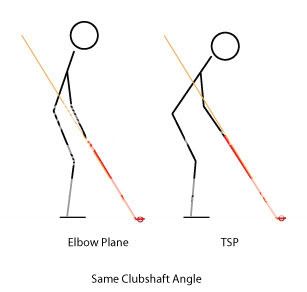
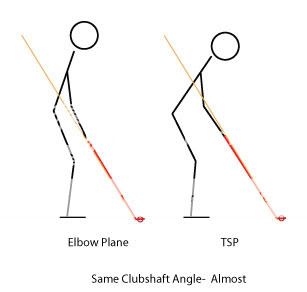
Much of the difference between the TSP and Elbow Plane is Posture. Add a little #3 Accumulator Angle and Shazam!...:)
Quote:
 |
Quote:
Right shoulder moving down OUT and forward . . . |
Quote:
Nice ........gotta get my book , there's something about this in there, somewhere. Waist bend. |
Quote:
|
1 Attachment(s)
Quote:
You want the Pivot via the Right Shoulder to take the Hands down plane towards the plane line/ base line in Startdown, right? The reasoning behind the TSP angle(s). But if the Right Shoulder is above the Inclined Plane (as formed by the Hands and Base Line) , wouldnt the Right Shoulder have to move towards a point above/beyond the Base Line to get the Hands to go towards the Base Line? I dunno. Hands direct the Shoulder to turn towards where ever , Hands to Pivot, it all works out? With TSP angle you get a definite Alignment with the Right Shoulder moving towards the Base Line in Startdown (only) as if it was gonna smack the ball. Im getting real fond of that actually, then a little Throw and Release. Three stage rocket. Hey Bucket, look at what this guy is up to. Towel drill, Rotated? Is it a TSP too or not? |
Quote:
There's a second "clear the Right Hip" in 12-3 too.......prior to Startdown I believe, dont have my book with me, which I think relates to the Delayed turn with a Hip Slide. This clears a nice path for the right elbow to pass on the downstroke. Hogan might have the blended the two into one movement......turnandslide. That guy cleared his Right Hip ......he had to, to attack from the inside like he did. "Well the most important move in golf is the movement of the lower body". Nowadays some people think you can avoid the slide all together and just turn..... interesting stuff. |
Well, I can understand how someone with a Shoulder Turn Takeaway would have a problem Clearing the Right Hip. Golfers using the Right Forearm Takeaway shouldn't have that problem.
The Yellow Book is a little confusing regarding these procedures. In 10-15 Delayed Hip Action, the Shoulders lead the Hip Turn during the Backstroke. This is a Right Forearm Takeaway Procedure. An Option for Shoulder Turn Takeaways is to move the Right Hip out of the way before Start-up. It gets more confusing in the 7th Edition, "Delayed Hip Action is the only Variation that assures "Clearing the Right Hip" in both directions (2-N-0)." |
Quote:
You want the Pivot via the Right Shoulder to take the Hands down plane towards the plane line/ base line in Startdown, right? In some motions I believe this is correct for some plane angles . . . Here's Brian perfectly on plane . . . seems to be directing his hands toward the plane line . . . 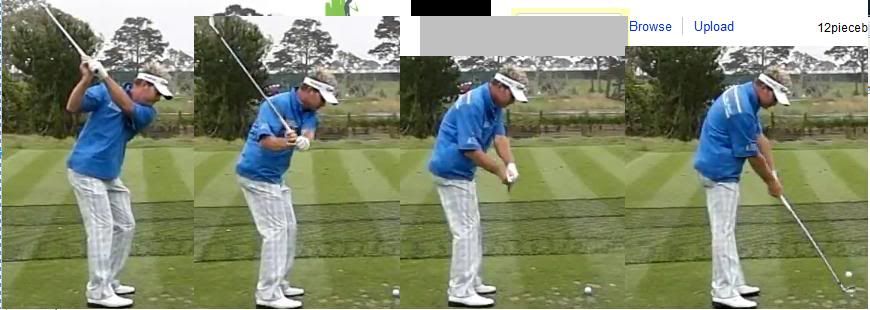 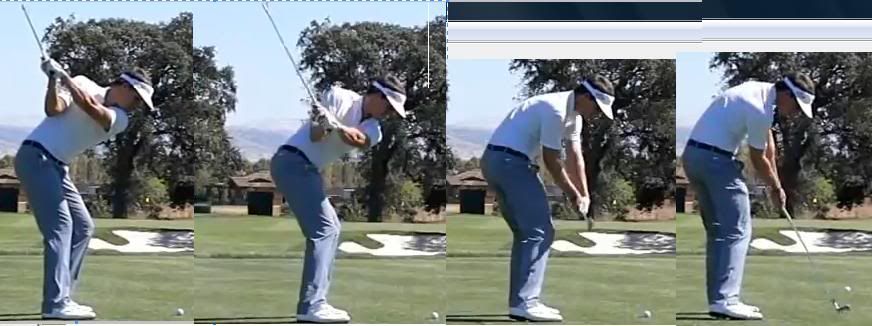 Lovemark on the other hand I would say has an entirely different intention in terms of where his hands are being directed. Note the difference in the relationship of the shoulders to the hands. Note the angle of the left arm when it is parallel to the ground and its relationship to the stance line. Note the difference in the relationship of the left arm to the ground at "delivery" . . . Lovemark seems to be directing his hands at a point INSIDE the plane line . . . and the respective shoulder motions seem to me to support this "intention". But if the Right Shoulder is above the Inclined Plane (as formed by the Hands and Base Line) , wouldnt the Right Shoulder have to move towards a point above/beyond the Base Line to get the Hands to go towards the Base Line? I believe you are correct in regard to this statement . . . If you were able to track the motions of the right shoulder you would see that Lovemarks shoulder motion is likely pointing outside/above the plane line . .. supporting that particular handpath. |
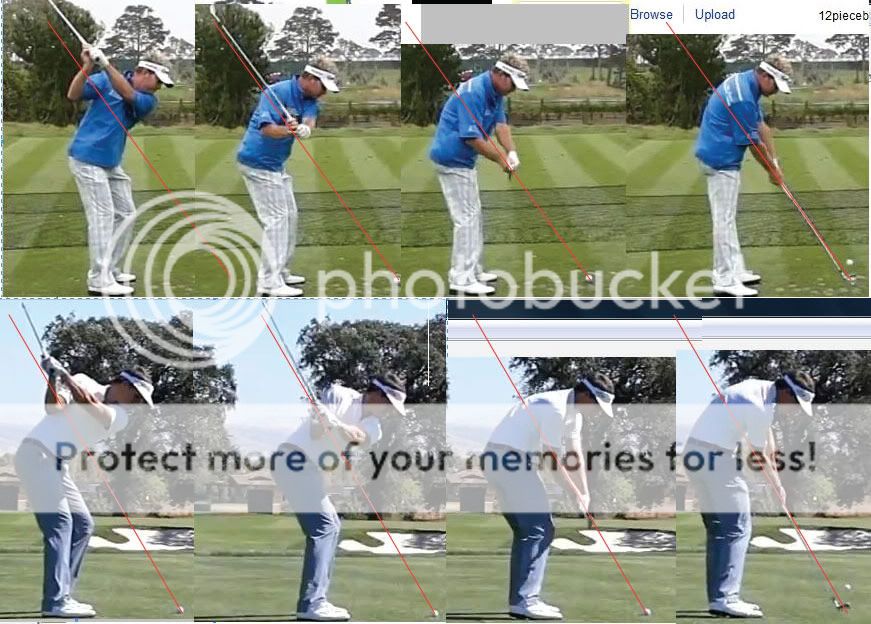 |
Quote:
Quote:
In my mind, if you look at Mr. Gay's shoulder turn as compared to Mr. Lovemarks, they are very similar in their inclination to the spine, which is exactly what I was trying to say. Bucket and Daryl do such a good job of showing it visually. Thanks Guys!:salut: Kevin |
Quote:
Its a poor Zone 1 issue, then throw in a poor right shoulder motion. I have found though the better the right shoulder works (on plane) the less a Zone 1 issue is created. When I miss around with Rotated Shoulder turn it seems to create a better alignment with the shoulders on the downswing.........but it feels like crap to me, less powerful as well. |
Quote:
Reminds me of a comment from YODA. Rotated Shoulder Turn is great, as long as you always play down wind. :naughty: :) :laughing9 Kevin |
The difference in Right Forearm alignments at the delivery position are pretty drastic in those pictures. I always thought the ideal was Lovemark because its pointing at the ball and not coming in "too high"....I think reading this my understanding is wrong....is it just a matter of being on plane at impact?
I agree with Bucket on the right shoulder on the downswing, going back to his epic thread a few months ago. |
Quote:
|
How "big" is chapter 13??
I think that "enough" consideration of component compatability is often lost! Compatability? Although components may have numerous variations their Compatability with preceeding and following componentn variations gets lost. This thread may be a fine example of that. Shoulder action, hip action etc. are likely very dependent on , such as, Address position, Adjusted?, FIX, etc. and very dependent on elbow position, Pitch?, Punch?, etc. So I more likely think to myself "how does that component variation selection FIT between the "bookend" components (with their selected variation). HK I am sure you said that, in a very articulate way, probably in the Preface. But I aint't gona look for it BECAUSE I think that EVERYONE should REDISCOVER that on their own.:)
HB |
Quote:
Is it just me or does Brian look a tad laid off there at Top? Dont think Ive seen that in any of his recent swings. Ever so slightly arched? Any who both those guys get on their Impact Plane Angles really early .......the sooner the better to my mind. Both have a very minimal shift from Top to get down there too......also a very good thing to my mind. In the first frame Brian is TSP'n it , in the second frame he's TSP and has dropped down to his Impact Plane Angle so he has shifted if ever so slightly during Startdown. Double shift but very minimal in terms of degrees ......something I think makes good sense if shifting is hazardous. Lovemark's Rotated but doesnt shift much either. I say Rotated but if he Slides and Tilts his Axis it wont be Rotated by definition anymore. Not sure if he does that or not. If he does it Rotated/Down combo maybe even though its not actually planed like Bucket says? Still dont have my book with me to look up the proper terminology. Anyways in regard to this posts initial question: Look at Brian Gays first frame there. Since we're talking Homer and Lynn around here assume he wants a TSP angle at Top. (And I do have to state a preference for them personally) He's got himself on one there nicely, fairly close to his Impact Plane Angle which D has drawn for us right? Not much of a shift required therefore. Now imagine him making a steeper turn of the shoulders in Startup.......in doing so he'll find a TSP angle which is further away from the Impact Plane Angle , the red line there....... Requiring a bigger shift on the way down in terms of degrees. Bigger shift bigger hazard. Thats my final answer on Flat back, why? Im interested in other opinions .......Rotated , Right Shoulder above Plane .....interesting stuff. |
Quote:
Rotated/Rotated was short shots only, wasnt it? |
Just Thinking
Quote:
My thinking: No, No, No, 1-L can do R/R, and LONG shots, but, not musch else- no shift or slide etc. :lurk: HB |
Quote:
How does that happen? Well, it's an Alignment. If you stand behind the Golfer (during Impact) and look down his Right Shoulder, down the Angle of Approach of his Right Forearm, are the #3 PP, Elbow and Right Shoulder in Alignment to the Angle of Approach. It doesn't mean that the Right Shoulder stays On-Plane all the way until Impact or how high or low the Right Forearm. And, you can't measure that from drawn lines of a down the line view as in the photos of these two golfers. To see if you're getting Right Shoulder support, tie a string from your Right Shoulder to your #3 PP, and imagine a vertical plane of the string. Then at Impact, is your Elbow aligned/touching that String Plane? |
| All times are GMT -4. The time now is 07:15 AM. |