Bobby Clampett 1983 Swing Sequence With Analysis By Homer
The Golfing Machine - Basic
|

04-26-2006, 03:29 PM
|
 |
Administrator
|
|
Join Date: Jan 2005
Location: Atlanta, Georgia
Posts: 10,681
|
|
|
Bobby Clampett 1983 Swing Sequence With Analysis By Homer
Here is Homer Kelley's original analysis of Bobby Clampett's swing for the April 1983 edition of Golf Magazine. His commentary on each of the eleven photos in this swing sequence is presented unedited, exactly as Homer wrote it.
 Address.
 Bobby's address is a three-step routine to set up the inclined plane for clubshaft guidance, the knee and waist bend needed to hold the head still, a palms together grip with the left wrist flat (not bent either way), level (neither cocked or uncocked), and vertical (to the ground, not rotated), and to rehearse all the selected relationships and alignments including a through the ball plane line (base edge of plane), and the waggle to establish clubhead feel against the first joint of the right forefinger. This is not a clubshaft "feel" but the sensing of the longitudinal center of gravity (sweet spot plane of rotation). That pressure point is used like the lens of a flashlight strapped to the right forearm to shine its light along the plane line during takeaway and release. The left hand is not held square to the target line but closes (like a door) for true rhythmic power generation.
 Backstroke.
 After the address routine and a preliminary turn of the right hip, the right forearm takes the hands and clubhead back-up-and-in simultaneously and instantaneously and the shoulder turn is as flat as possible and independent of the takeaway action. The left knee flexes only enough to keep the head still and hold it in a strong solid position. Bobby's right elbow appears unusually high here which may be intentional and for a purpose. It appears to be a shoulder turn takeaway action. That always produces an automatic and unintentional shift from a flat first plane to a steeper plane at the top. That could lock a player into a pivot controlled hands procedure unless carefully realigned during the interval at the top. Then it can again be the Golfing Machine hands controlled pivot procedure.
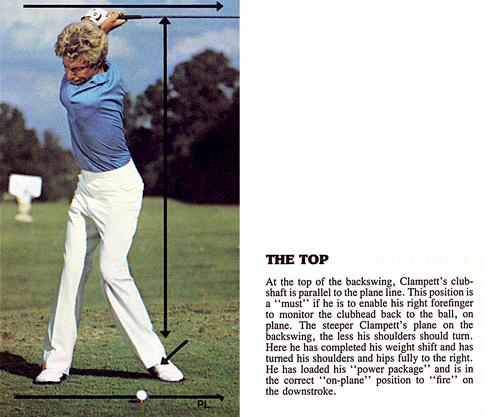 The Top.
The clubshaft parallel to the ground must also be parallel to the base line of the plane (plane line). When not parallel it must be pointing at it. All elements of the stroke must be adjusted and aligned during this particular interval in order to move precisely toward the plane line guided by the #3 pressure point (right forefinger clubhead feel). The shoulder turn function here is to place the right shoulder precisely on the inclined plane. Therefore it is mandatory that the steeper the plane the shorter the shoulder turn and foot and knee action must be no more than needed to accomplish those relationships.
 Start Down.
 It is recommended that the hip turn be preceded by a hip slide parallel to the plane line so body power (the coiled left side) then can pull the butt of the clubshaft and the right shoulder toward the plane line before the pivot can turn itself too far inside the plane line and have to stretch unnecessarily to reach the ball. This also disrupts the pivot component release sequence necessary for this swinging procedure of longitudinal acceleration of the clubhead which duplicates the process of pulling an arrow from a quiver which motion is to be maintained until the release swiches ends with adjustable rapidity. The knees passing through the sit down position maintains the left side assignment of turning the body to generate centrifugal force. Power package muscle power (right triceps thrust) can make a miniscule contribution and only with great effort during a swing procedure.
 Downstroke.
 Bobby is in a bit of a bind here because his left shoulder instead of his right shoulder moved downward. But he can and does recover in time for release. A common present-day misconception is surfacing here. That is, a partial, preliminary weight shift through knee motion instead of hip motion which disrupts the on plane start down shoulder turn essential to establishing the precise direction fo both the hands and the clubhead for cranking up the gyroscope of the circling clubhead. Maximum #2 accumulator power (the wristcock) is moving strongly down plane completely contained and retained for the snap release (maximum triggering delay) which is mandatory for developing the clubhead speed and power that Bobby is noted for.
__________________
Yoda
|
|
01-11-2010, 09:06 AM
|
 |
Lynn Blake Certified Associate
|
|
Join Date: Apr 2008
Location: Wisconsin
Posts: 1,955
|
|
|
Hi BamBam,
I appreciate you posting this series again. Could you please clarify something for me? Who's notes are to the right of each picture, and who's notes are below each picture?
Thanks very much!
Kevin
__________________
I could be wrong. I have been before, and will be again.
ALIGNMENT G.O.L.F.
|
|
01-11-2010, 09:21 AM
|
 |
Lynn Blake Certified Senior Instructor
|
|
Join Date: Jan 2005
Location: Massachusetts
Posts: 1,334
|
|
|
The Good, The Bad and the Ugly
Originally Posted by KevCarter

|
Hi BamBam,
I appreciate you posting this series again. Could you please clarify something for me? Who's notes are to the right of each picture, and who's notes are below each picture?
Thanks very much!
Kevin
|
Homer's actual text below. Golf Magazine's editors to the right. The GM editor's version is what actually appeared in the magazine.
__________________
Drew
Let Your Motion Make the Shot.
|
|
01-11-2010, 09:33 AM
|
|
Lynn Blake Certified Associate
|
|
Join Date: Apr 2008
Location: Wisconsin
Posts: 1,955
|
|
|
Originally Posted by drewitgolf
|
|
Homer's actual text below. Golf Magazine's editors to the right. The GM editor's version is what actually appeared in the magazine.
|
Thanks Drew! 
Kevin
__________________
I could be wrong. I have been before, and will be again.
ALIGNMENT G.O.L.F.
|
|
01-11-2010, 12:00 PM
|
|
Senior Member
|
|
Join Date: Mar 2006
Posts: 3,433
|
|
|
Just read the old thread, Yoda was kind of feisty back in those days! Nice. Old time hockey.
I heard Gordie Howe on the radio a couple of days ago, his son Marty , a former All Star himself was on too.. Anyways Mr Hockey, Gordie , now into his golden years was waxing on about how things are different now and how back in his day, according to him anyways, he was "a clean" player.........To which his son could be heard to chuckle to himself some and then reply.........."ya Dad you were clean alright.........if you cut someone it was a CLEAN cut. Probably a real bleeder but a good clean cut".
Last edited by O.B.Left : 01-11-2010 at 11:18 PM.
|
|
01-11-2010, 12:10 PM
|
|
Senior Member
|
|
Join Date: Jan 2005
Posts: 695
|
|
|
"That always produces an automatic and unintentional shift from a flat first plane to a steeper plane at the top. That could lock a player into a pivot controlled hands procedure unless carefully realigned during the interval at the top. Then it can again be the Golfing Machine hands controlled pivot procedure."
I find if using a shoulder turn takeaway I have to really fire the hip turn to make consistent contact. Could this be why?
|
|
01-11-2010, 03:13 PM
|
|
Senior Member
|
|
Join Date: Jan 2005
Posts: 214
|
|
|
Research Subjects
I think Mr Kelley in these comments provided much in terms of research subjects. Also, I had not previously noticed that Transfer Power is not include as one of the Chapter 8 sections.
DRW
*Address….with the left wrist flat (not bent either way)………clubhead feel against the first joint of the right forefinger. This is not a clubshaft "feel" but the sensing of the longitudinal center of gravity (sweet spot plane of rotation).
*Backstroke…….the shoulder turn is as flat as possible and independent of the takeaway action.
*The Top……..The shoulder turn function here is to place the right shoulder precisely on the inclined plane. Therefore it is mandatory that the steeper the plane the shorter the shoulder turn …
*Start Down……so body power (the coiled left side) then can pull the butt of the clubshaft and the right shoulder toward the plane line …
*Down Stroke….A common present-day misconception is surfacing here. That is, a partial, preliminary weight shift through knee motion instead of hip motion
*Release Point….a true horizontal hinging motion (like a swinging door) ……... Only this hinging can produce the consistent power of true rhythm.
*Release Interval….The ideal #3 accumulator (the angle formed by the left arm and the clubshaft) application shown here is the true high velocity clubhead motion overtaking the left arm and is true rhythm, entirely different from and independent of pace.
*Impact……The magical right forearm is again on plane ……. The right wrist shows slightly more bend than at address. Therefore there is a deviation in left wrist flatness, though not visibly perceptible….
*Follow-Through…by reducing shoulder turn the hands can be automatically stopped at any selected point -- no more double impact putts -- by prepositioning the shoulders with the club at the desired limit point.
*Transfer Power……Swivelling is a true rotation of the hands -- not the closing motion of the flat and vertical left wrist performing the hinge action. Therefore, the right hand rolls over the top of the left wrist.
*The Finish…….Hackers have both an inadequate follow-through and an artificial finish. The finish has the rank of a station in the Star System Triad for simplified golfing but impact does not. Endowing impact with improper importance and attention has caused players to "chop" at the ball and has been producing hackers for centuries. … After the follow-through, this is the second great step out of Hackerville.

|
|
01-11-2010, 08:31 PM
|
|
Senior Member
|
|
Join Date: Mar 2006
Posts: 3,433
|
|
|
Originally Posted by mb6606
|
"That always produces an automatic and unintentional shift from a flat first plane to a steeper plane at the top. That could lock a player into a pivot controlled hands procedure unless carefully realigned during the interval at the top. Then it can again be the Golfing Machine hands controlled pivot procedure."
I find if using a shoulder turn takeaway I have to really fire the hip turn to make consistent contact. Could this be why?
|
I dont know mb, but I can elaborate a little on Mr Kelley's remarks given some earlier posts on the subject. Maybe it will help you, maybe not.
Basically, to employ a Shoulder Turn Takeaway (Pivot to Hands by definition) is to allow the Shoulders to take the Hands back in the direction that they the Shoulders are traveling. Always under the Inclined Plane (because the Shoulders dont travel the Plane). This is always a flat initial plane angle (most likely an Elbow Plane) to begin with and necessitating a Plane Shift, upwards, to get the club to Top. Homer felt Plane Shifts, while not inferior mechanically where hazardous in terms of consistency. So far the count on Plane Shifts, given a Shoulder Turn Takeaway stands at ONE.
From Top, IF the Golfer has been lucky enough to land on or locate a Turned Shoulder Plane Angle he may revert to an Alignment Golf Hands to Pivot methodology and use an On Plane Shoulder Turn in Startdown to take the Hands (which are now directing things via pressure points to brain dialogue, towards the plane line) Down Plane.
The more likely situation (especially back in the day of the sky high backswing) is that the golfer locates a Plane Angle above a Turned Shoulder Plane at Top. Which for a TGM type Hands controlled Pivot Startdown procedure would require him to drop his Hands and Plane Angle to a TSP angle prior to a Hands directed On Plane Shoulder Turn move of the Right Shoulder towards the Plane Line in Startdown. Or, the far more common, shift down to an even lower Elbow Plane for further a continuation of the Pivot to Hands procedure. Either way the Plane shift count is now Two. Double Shift.
If you are the type of player that drops back to an Elbow Plane in the downswing then Id imagine that it would feel very rotational to you after you got down there. I does for me anyways, when I goof with that Double Shift. Maybe thats what you are feeling in regards to the Hip Turn?
Homer said that Pivot to Hands and the Elbow Plane were very compatible....... but he had an obvious preference for Hands to Pivot to say nothing of a RIGHT FOREARM TAKEAWAY which would have the Hands and Shoulders traveling different paths with the Hands on the Inclined Plane and directing things, Tracing from the beginning. The Pivot enabling, complying with the Hands controlled Pivot and On Plane procedure.
Last edited by O.B.Left : 01-11-2010 at 11:33 PM.
|
|
01-11-2010, 11:54 PM
|
|
Senior Member
|
|
Join Date: Jan 2005
Posts: 695
|
|
|
OB,
Well thought out post and yes the elbow plane I feel I need a lot more pivot rotation. Thanks
|
|
| Thread Tools |
|
|
| Display Modes |
 Linear Mode Linear Mode
|
 Posting Rules
|
You may not post new threads
You may not post replies
You may not post attachments
You may not edit your posts
HTML code is Off
|
|
|
All times are GMT -4. The time now is 01:30 AM.
|
| |


